
Here are the US banks at risk
How are US credit groups today facing the prospect of withdrawals from customers on a mass scale? The overview signals strong vulnerability, with few exceptions
Why has Wall Street suddenly targeted regional institutions? Because, on one hand, at the behest of a law enacted during the Trump Administration, they have fewer stress test requirement and less stringent regulations imposed post-2008 on larger institutions. And on the other hand, when a bank is shut down, as it is the current case with the Silicon Valley Bank (SVB), because it can no longer meet the demand for withdrawals from its customers’ accounts, the doubt that it is not just one black sheep is more than legitimate.
However, what does the situation of US listed local and regional banks look like? Looking at the table (Source: Bloomberg), which precisely lists all local footprint institutions ranked by stock market value (the top two capitalize more than Intesa Sanpaolo), some interesting data emerge. The first surprising data is the percentage of deposits to total assets: the higher the percentage the greater the structural imbalance of the institution, because it is more exposed to a potential bank run. In the case where there is a strong deposit component, it is therefore necessary to see how much liquidity the institution can dispose of in case things at the level of demand for withdrawals from accounts go bad. This liquidity can be pure cash, to which can be added the repurchase agreements that the bank operates with customers, and also available-for-sales (AFS) bonds, namely those destined for sale and therefore almost always of short maturity (although in the SVB case this may not have been the case). Finally, the sum of these liquid assets was compared to the total assets of the bank itself, again to see the potential mismatches between durations.
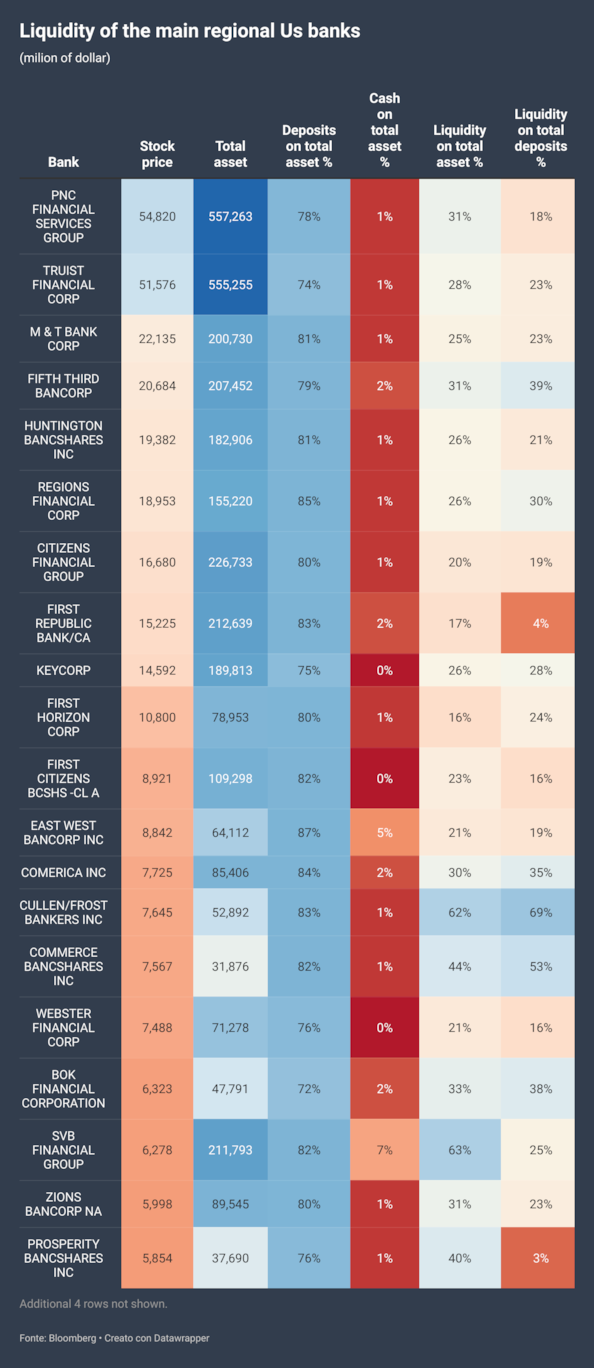
From the table we first see that even the large-capital regional banks —the first two, although they have fallen conspicuously in the stock market, still capitalize more than Intesa Sanpaolo— have a percentage of deposits hovering around 80% of total assets, with peaks of 90%. Ahead of this preponderance of demand deposits, cash does not exceed a few percentage points. In the broader case of liquidity, as described above, the range is still between 20% and 30% of total assets, with a few exceptions above 60%.
However, this should not come as a surprise. The role of a banking institution is to accumulate money from retail customers to reinvest it through loans to be disbursed. However, it is clear that few institutions would actually be ready to respond even at the first signs of a bank run, which is why it is important to trust the system. So, this explains the intervention within 24 hours of the authorities for the protection of the deposits (FDIC) and regulatory authorities (Fed).
What happened on Monday 13 at Wall Street, with the S&P Regional Bank Index down by 10.84%, is a reminder of what could happen if investors lose this confidence. In fact, despite the large losses, the correlation between the stock market performance of the various commercial banks and their liquidity (estimated as the ratio of liquid assets to the amount of deposits) was positive, although not significant (15%). As a result, the conspicuous fall in prices was dictated mainly by the risk of lack of solvency of individual institutions, rather than by a lack of confidence in the system. If the latter were to come to lack, the escape routes would not be wide enough to accommodate everyone and the losses would be far worse. (All rights reserved)


