
 English
TikTok takes on Meta in the social shopping segment
«The phenomenon has already exceeded 1.3 trillion dollars annually», PwC explained to MFF. By 2030, this figure is expected to surge to 8.5 trillion. Beauty and fashion are the best-selling categories. While Facebook and Instagram hold 47% of the market, the Trendy Beat feature on the Chinese social media platform, which aims to internally produce goods, has Amazon and Shein concerned

TikTok aims to achieve an annual gross merchandise value (GMV) of 20 billion dollars (18.2 billion euros). According to Reuters, this objective underscores TikTok’s efforts to leverage its increasing popularity to become a key player in the social shopping landscape. This business, which combines entertainment and online shopping, generated nearly 1.3 trillion dollars (1.187 trillion euros) in global turnover in 2023, with expectations to reach 8.5 trillion dollars (7.767 trillion euros) by 2030, as highlighted by PwC. ByteDance, the parent company based in Beijing, is strategically positioned to secure a significant share of this growing market, aiming to surpass its competitor, Meta. According to Statista data, Facebook and Instagram, which decided to shut down its internal shopping feature last year, are the leading social platforms for purchases, chosen by 27% and 20% of total digital buyers, respectively. TikTok and YouTube follow closely with 8% each, while WhatsApp, also under Meta, claims 7%.

With the aim of capitalizing on its growing popularity, ByteDance launched its shop in Western markets in 2021, with the UK selected as its first foreign market. This move seeks to replicate the success of Douyin, the Chinese version of TikTok, which has achieved annual sales of up to 10 billion dollars (9.1 billion euros) since its launch in 2017. «Social shopping has deeper roots in Asia, especially in China, thanks to a combination of cultural, technological, and market factors», Erika Andreetta, Partner at PwC Italy emea Luxury & Fashion, explained to MFF. «The early adoption of digital technology, widespread smartphone usage, and the vertical integration of platforms providing a comprehensive solution encompassing payment services, social media, and e-commerce all contribute to fostering greater adoption», she added. Apart from China, these factors have also propelled Indonesia to become one of the primary markets for TikTok shop. However, this momentum faced a setback last October when the Jakarta government suspended this function. Nevertheless, ByteDance responded by acquiring 75% of Tokopedia, Indonesia’s leading e-commerce platform, for 840 million dollars (768 million euros) through its tech conglomerate, GoTo. This strategic move underscores TikTok’s commitment to expansion within the market.
Following a sluggish start in the UK, the platform has reshaped its strategy in the Western markets, introducing new features that have significantly broadened its reach. Notably, Trendy Beat, launched in June of last year in the UK, allows users to purchase items featured in viral videos, which are produced by a Singapore-based company owned by ByteDance. This marks a pivotal moment in TikTok’s rise in e-commerce, as it formally integrates into the supply process, posing a potential threat to giants like Amazon, Shein, and Temu. Despite closing the last fiscal year with a turnover of 513 billion dollars (469 billion euros), Jeff Bezos’ Giant must now reckon with the Chinese Company’s prowess in trendsetting and its commitment to capitalizing on what essentially constitutes its distinctive trait. According to Andreetta, «in the UK, TikTok currently boasts a user base of 23 million and an audience of over 1.5 million registered businesses. We anticipate the platform could generate quarterly sales of 20 million dollars». In September, e-commerce was also launched in the US. However, a new legislative proposal threatens to curtail this promising market, potentially compelling ByteDance to divest its platform within the next six months to continue operating in the country.
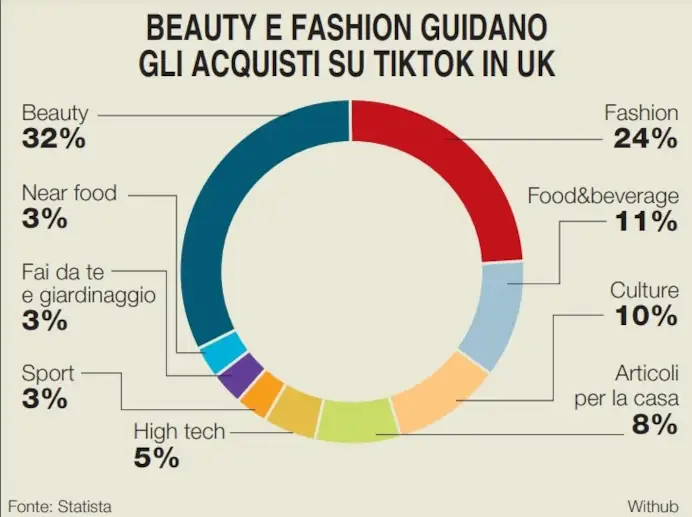
What about Italy? «TikTok Shop has the potential to succeed in Italy as well, tapping into the platform’s extensive user base and their high engagement levels. Success hinges on adapting the approach to suit local market dynamics, including the preferences of Italian consumers and the presence of both domestic and international brands», the analyst explained to MFF. Currently, health and beauty products dominate purchases, accounting for 32% of sales in the UK in 2023 and a staggering 85% during TikTok Shop’s debut month in the US. The luxury sector also holds potential, provided an aura of exclusivity and a high-quality customer experience are maintained, as highlighted by PwC. «TikTok Shop presents a compelling opportunity for luxury brands seeking to attract Generation Z and millennials», Andreetta explains, highlighting how «investing in social shopping represents an excellent opportunity for brands, especially in a context where the ROI of traditional performance marketing methods, such as pay-per-click advertising on search engines, display advertising, and email marketing, is declining due to escalating costs and market saturation».
Thus, social shopping presents a new opportunity that could help advertisers engage their target audience, particularly as traditional channels face challenges. According to Contentsquare, 55% of websites experienced a decline in web traffic in 2023, with a 5.5% decrease in conversion rates. In this scenario, social platforms have emerged as dominant drivers of web traffic, with the time spent on TikTok and Mark Zuckerberg’s tech conglomerate apps increasing annually by approximately 7%.
The ban on ByteDance in the US could cost 16 billion dollars
Last week, members of the US Congress passed a bill aimed at compelling ByteDance to divest its micro-video application to a non-Chinese entity within six months, under the threat of a complete social media ban in the country. The measure that Washington would enact to safeguard national security must pass through the Senate and obtain President Joe Biden’s signature to become effective. This attempt was already made by Trump in 2020, who, in his current election campaign, has changed his stance to target Zuckerberg’s tech giant.

It has only been a few months since Bytedance’s e-commerce entered the US market in September. However, according to the Financial Times, it has already generated 16 billion dollars (14.7 billion euros) in annual sales. This figure highlights both the Group’s significant size and the potential consequences of the ban. If the halt does not occur, eMarketer predicts that Facebook and Instagram will maintain their lead with an estimated 64.4 and 48.8 million buyers, respectively, by 2024, while TikTok will reach 40.7 million, continuing its upward trajectory observed since 2023. Last year, the Chinese social platform gained more customers, approximately 11.6 million in total, compared to the combined net increase of Meta’s two apps and Pinterest (6.4 million). The US TikTok shop currently «boasts a pool of 33.3 million social buyers, with 250,000 registered businesses», Erika Andreetta, a partner at PwC Italy EMEA Luxury & Fashion, explained to MFF. 85% of the market in the country is dominated by purchases in the beauty and fashion sectors, followed by 11% in food, and the remaining 5% in household items. Huda Beauty, Rare Beauty (a label that Founder Selena Gomez is reportedly considering selling for 2 billion dollars), and Maybelline are the top players in the social shopping sector. According to Statista, this sector is poised to reach a gross merchandise value (GMV) of 150 billion dollars in the country by 2028, doubling the estimated value for 2024. (All rights reserved)


Altre notizie


The fashion industry makes a plea to the Ministry of enterprises


